
You've decided you want to write software, and two languages keep showing up in every "learn to code" thread. Python is the most popular language in the world. Go is what a lot of the cloud runs on. Both are excellent, so asking which one is better won't get you far. What matters is which one fits where you want to end up.
The short version: if your goal is backend services, cloud, infrastructure, or just landing a software job, learn Go. That includes building products that call AI, like LLM-backed apps and the services that serve models in production. If you want to train models, do data science, or work in scientific computing, learn Python. The rest of this post explains why, with a primary source for every number.
TL;DR
- Go is the better choice for backend and cloud careers. It compiles to fast native code, has concurrency built in, and much of the modern infrastructure stack is written in it.
- Python is bigger. 57.9% of developers use Python and 16.4% use Go (Stack Overflow 2025), so Python has more total openings, especially in data and AI.
- Go is much faster on CPU-bound work. It runs roughly 30x to 244x faster than CPython 3, depending on the task (Computer Language Benchmarks Game).
- Most cloud-native tools are written in Go. That covers more than 75% of CNCF projects, including Docker, Kubernetes, Terraform, and Prometheus (go.dev).
- Pick Python if you're aiming at training models, data science, scientific computing, or quick automation scripts. It was the most-desired language in the 2025 survey.
- "AI" covers two different jobs. Training and analyzing models happens in Python (PyTorch, pandas). Building and serving the products around those models is backend work, which points to Go.
Table of Contents
- Go vs Python at a Glance
- Which Is Easier to Learn?
- How Different Is the Code?
- Performance: How Much Faster Is Go?
- Jobs and Demand in 2026
- When Python Is the Right Choice
- So Which Should You Learn?
- Keep Going
- Frequently Asked Questions
- Sources
Go vs Python at a Glance
Both languages are beginner-friendly and both get people hired, but they're built for different things. In the 2025 Stack Overflow survey, 57.9% of developers used Python and 16.4% used Go (Stack Overflow 2025). Python has the reach. Go has the speed, the concurrency, and a direct path into backend and cloud work.
| Go (Golang) | Python | |
|---|---|---|
| Typing | Static, checked by the compiler | Dynamic, with optional type hints |
| Execution | Compiled to a native binary | Interpreted at runtime |
| Speed (CPU-bound) | Very fast | Slower, often by orders of magnitude |
| Concurrency | Goroutines and channels, built into the language | Threads limited by the GIL (optional free-threaded build in 3.13+) |
| Learning curve | Small surface, 25 keywords, one obvious way | Reads easily on day one, large ecosystem to navigate later |
| Where it shines | Backend, cloud, infrastructure, CLIs, DevOps, serving AI in production | Training models, data science, scripting, automation, scientific computing |
| Developer usage (2025) | 16.4% | 57.9% |
| Best fit | Backend, cloud, and AI-product career track | Data-science and model-training track |
Which Is Easier to Learn?
Python is easier on day one. Go gets you to correct, production-shaped code sooner. Python's syntax reads almost like English, so your first working script comes quickly. Go asks for more upfront (types, an explicit main, handling every error), and that structure starts paying off once your programs grow past a toy.
Being easy to start and being easy to get good at are different things, and most "which is easier" comparisons blur them. Python gives you many ways to do everything, so beginners spend time choosing between styles and chasing mistakes that only show up at runtime. Go has 25 keywords, one formatter (gofmt), and a culture of "one obvious way" to solve a problem. The compiler refuses to build code with an unused variable, and that includes an err you assigned and never checked. You lose less time to style debates and late-night runtime surprises, and the habits you pick up hold up in real codebases.
Fast feedback matters most early on. A compiler that flags your mistake in a second teaches you faster than a runtime crash you find an hour later. You can feel the difference in the Go Fundamentals course, where every exercise compiles and runs in the browser and tells you right away whether you got it right.
How Different Is the Code?
Day to day, the code looks more alike than you'd expect, until you get to concurrency. Both languages have functions, loops, slices or lists, and maps or dicts. The visible differences are static types and how each language runs many things at once. Take a common real task: fetching several URLs at the same time.
Go has concurrency built into the language. A goroutine is a lightweight thread you start with the go keyword. This example uses WaitGroup.Go, added in Go 1.25, which starts the goroutine and tracks it in one call:
example.gogopackage main

import (
	"fmt"
	"net/http"
	"sync"
)

func main() {
	urls := []string{
		"https://api.github.com",
		"https://go.dev",
		"https://levelupgo.dev",
	}

	var wg sync.WaitGroup
	for _, url := range urls {
		wg.Go(func() {
			resp, err := http.Get(url)
			if err != nil {
				fmt.Printf("%s: %v\n", url, err)
				return
			}
			defer resp.Body.Close()
			fmt.Printf("%s: %s\n", url, resp.Status)
		})
	}
	wg.Wait()
}
In Python you reach for a library and a thread pool, because the standard interpreter runs one bytecode thread at a time:
example.pythonpythonimport requests
from concurrent.futures import ThreadPoolExecutor

urls = [
    "https://api.github.com",
    "https://go.dev",
    "https://levelupgo.dev",
]

def fetch(url):
    resp = requests.get(url)
    return f"{url}: {resp.status_code}"

with ThreadPoolExecutor() as pool:
    for line in pool.map(fetch, urls):
        print(line)
Both work, and for I/O like web requests, Python threads are fine. The difference shows up under load and on CPU-heavy work. Go schedules millions of goroutines across all your cores without extra libraries. Python's Global Interpreter Lock has historically let only one thread run Python bytecode at a time. That is starting to change. Python 3.13 added an optional free-threaded build that can disable the GIL, so the gap is narrowing. For now, Go's concurrency is still simpler to use and faster by default.
Performance: How Much Faster Is Go?
On CPU-bound work Go is much faster than Python, often by one to two orders of magnitude. As of 2026, the Computer Language Benchmarks Game shows Go running CPU-heavy tasks roughly 30x to 244x faster than CPython 3, depending on the workload (Computer Language Benchmarks Game). Go compiles to native machine code ahead of time. Standard Python interprets your code at runtime.
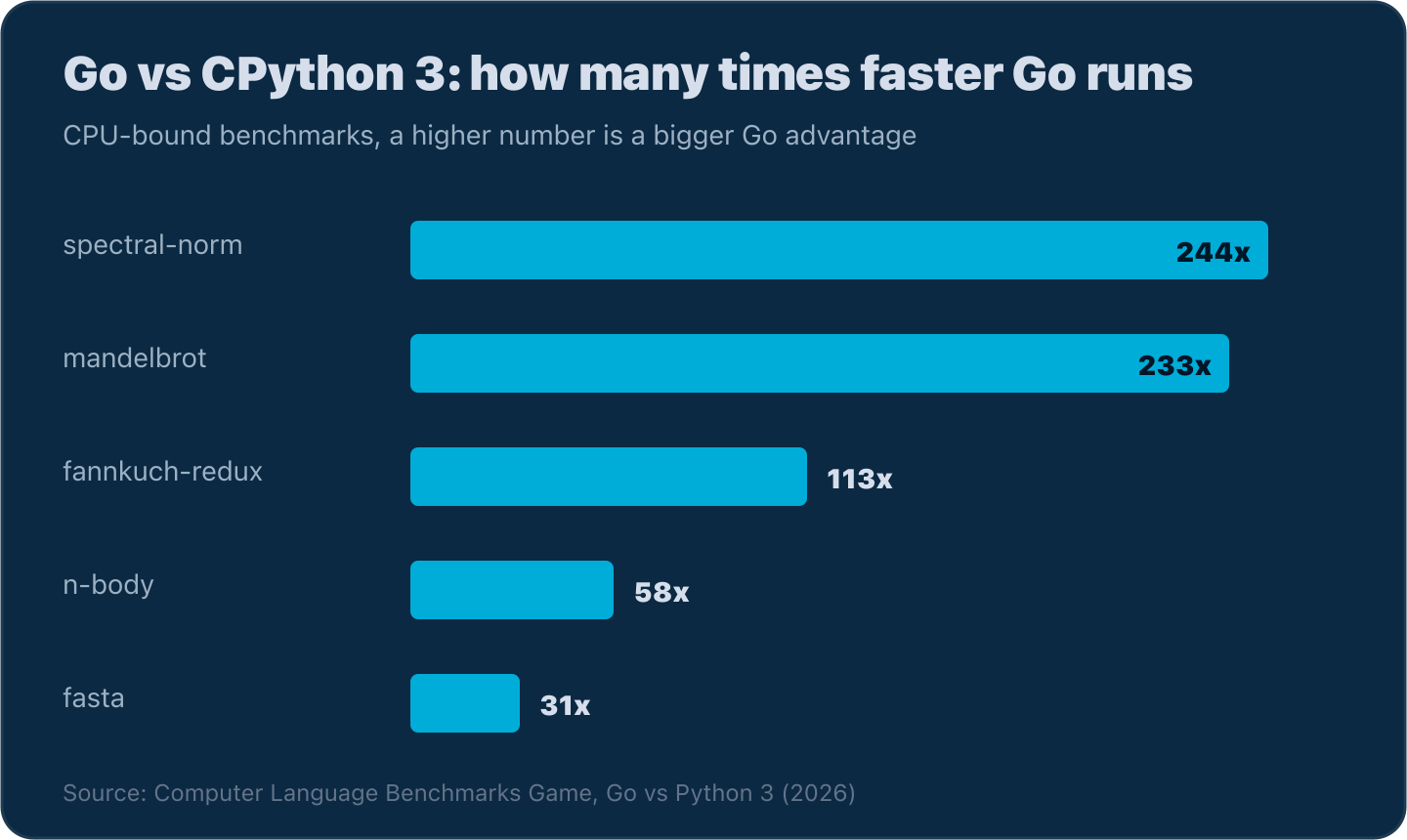
Source: Computer Language Benchmarks Game, Go vs Python 3 (2026).
As a beginner you don't need to care about the exact multiple. What matters is that compiled Go does the same work on much less hardware, which is why companies move hot services from Python to Go to cut their server bills. Tuning Go goes further still. Go's profile-guided optimization saved Uber about 24,000 CPU cores, and later garbage-collection tuning saved roughly 70,000 cores across 30 services (Uber Engineering, 2025). Learning Go gets you thinking about compiled-versus-interpreted tradeoffs from day one.
Jobs and Demand in 2026
Python has more job openings overall. Go's openings are more concentrated, with less competition for them. The raw numbers first: in Stack Overflow's 2025 Developer Survey, 57.9% of developers reported using Python versus 16.4% for Go (Stack Overflow 2025). Python is used almost everywhere, so it shows up in more listings.
Go's advantage is focus. Go roles cluster in backend, cloud, infrastructure, and platform engineering, areas with strong demand and comparatively few applicants who write idiomatic Go. More than 75% of Cloud Native Computing Foundation projects are written in Go, including Docker, Kubernetes, Terraform, and Prometheus (go.dev, 2026). If you learn Go, you're writing the same language as the infrastructure those jobs are built on.
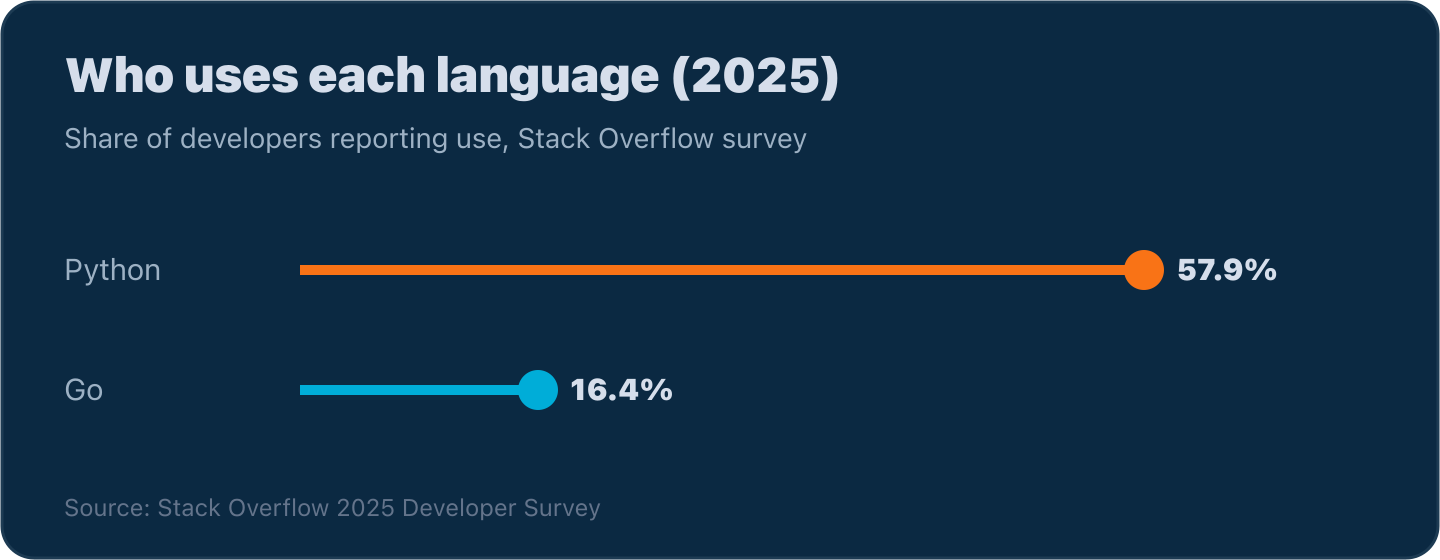
Source: Stack Overflow 2025 Developer Survey.
A note on pay, since the internet is full of confident salary splits. Stack Overflow doesn't break compensation down cleanly by single language, and most of the "Go pays X, Python pays Y" figures going around trace back to SEO blogs rather than primary data. What you can say is that Go roles tend to sit in backend, infrastructure, and senior engineering bands, which pay well. Pick the role you want and let the language follow from that.
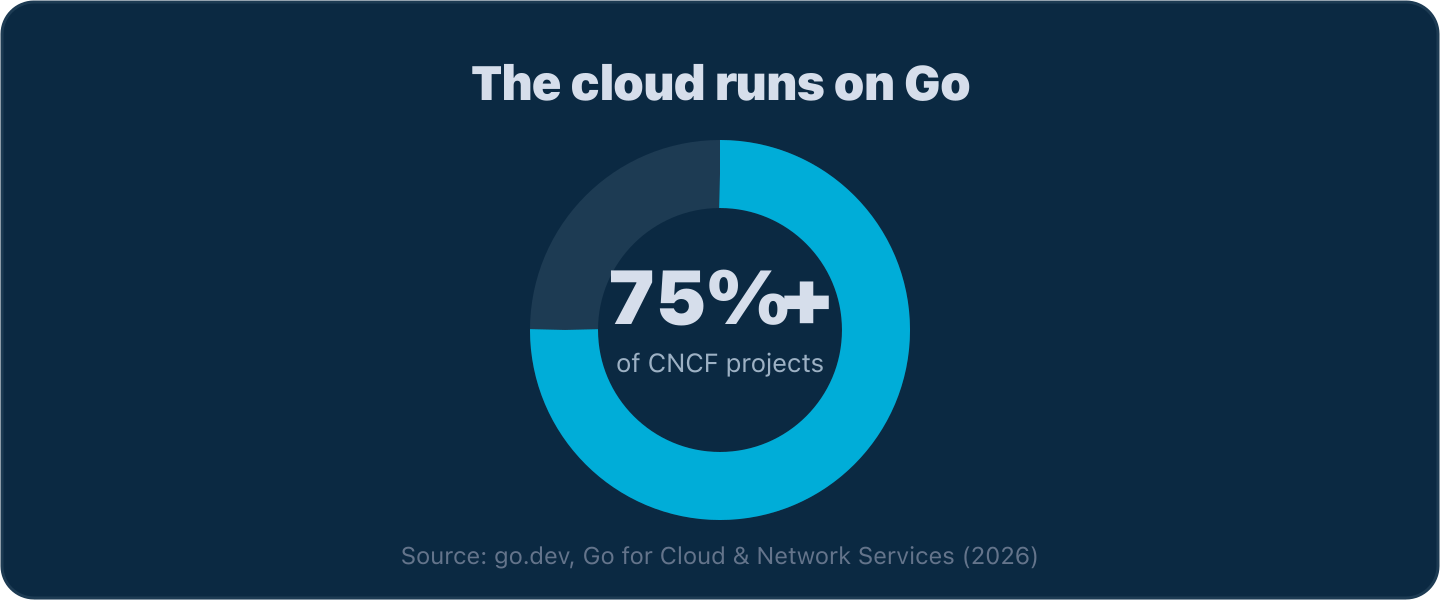
Docker, Kubernetes, Terraform, and Prometheus are all written in Go. Source: go.dev, 2026.
When Python Is the Right Choice
If you're heading into data, model training, or science, pick Python. It's the default language of machine learning, data analysis, scientific computing, and most introductory CS courses, and nothing else has tooling as good in those areas. It was the most-desired language in the 2025 Stack Overflow survey, and on GitHub it's the #2 language by usage, with contributor numbers up 48% year over year (GitHub Octoverse 2025).
Let where you want to end up decide this, not a popularity score. If you picture yourself training models, analyzing datasets, automating spreadsheets, or doing research, Python's libraries (NumPy, pandas, PyTorch) put you to work on day one, and Go has nothing equivalent. If you picture yourself building APIs, services, CLIs, or cloud infrastructure, Go gets you there with less ceremony and better performance. You can always add the other language later. Many engineers do.
AI needs its own paragraph, because "AI work" is really two jobs. Building and training models, and the data analysis around them, belongs to Python, and Go has no equivalent there. Building the product on top is a different job: the LLM-backed backend, the retrieval and orchestration plumbing, the service that serves a trained model under load. That's backend work, and Go is very good at it. Ollama and many vector and orchestration systems are written in Go themselves. So if your AI goal is to ship an AI-powered app rather than train the model, Go is the better pick.
Already a Python developer eyeing backend work? You don't have to start over. The mental shifts are smaller than they look, and our guide on switching from Python to Go walks through them. If you're still deciding whether Go belongs in your toolkit at all, see should you use Go as your first programming language.
So Which Should You Learn?
Let your goal decide. The flowchart below puts the same advice in one picture. Backend, cloud, and AI-product goals point to Go. Model training and data science point to Python. If you're unsure but want strong fundamentals and fast feedback, Go is the safer default.
flowchart TD
    Start(["`**Should I learn Go or Python in 2026?**`"])
    Start --> Q1{"`What is your main goal?`"}

    Q1 -->|"`Backend, cloud, infra, AI-powered apps, or a dev job`"| Go(["`**Learn Go**`"])
    Q1 -->|"`Train models, data science, or research`"| Py(["`**Learn Python**`"])
    Q1 -->|"`Not sure yet`"| Q2{"`Want fast feedback and strong fundamentals?`"}

    Q2 -->|"`Yes`"| Go
    Q2 -->|"`I just want quick scripts`"| Py

    Go --> GoNext["`**Your path**
    ─────────────
    Static types · goroutines
    Compiled, fast binaries
    Runs the cloud-native stack
    Backend, APIs, AI-app serving`"]

    Py --> PyNext["`**Your path**
    ─────────────
    NumPy · pandas · PyTorch
    Train and analyze models
    Data science and research
    Scripting and automation`"]

    classDef start fill:#0b2942,color:#d6deeb,stroke:#1d3b53,stroke-width:1px,rx:8,ry:8
    classDef question fill:#0b2942,color:#d6deeb,stroke:#1d3b53,stroke-width:2px
    classDef goPick fill:#00ADD8,color:#011627,stroke:#5DC9E2,stroke-width:3px
    classDef goPanel fill:#0b2942,color:#d6deeb,stroke:#00ADD8,stroke-width:2px,rx:6,ry:6
    classDef pyPick fill:#f97316,color:#011627,stroke:#fdba74,stroke-width:3px
    classDef pyPanel fill:#0b2942,color:#d6deeb,stroke:#f97316,stroke-width:2px,rx:6,ry:6

    class Start start
    class Q1,Q2 question
    class Go goPick
    class GoNext goPanel
    class Py pyPick
    class PyNext pyPanel

    linkStyle 0 stroke:#7a8fa3,stroke-width:1.5px
    linkStyle 1 stroke:#00ADD8,stroke-width:2.5px
    linkStyle 2 stroke:#f97316,stroke-width:2.5px
    linkStyle 3 stroke:#7a8fa3,stroke-width:1.5px
    linkStyle 4 stroke:#00ADD8,stroke-width:2.5px
    linkStyle 5 stroke:#f97316,stroke-width:2.5px
    linkStyle 6 stroke:#00ADD8,stroke-width:2.5px
    linkStyle 7 stroke:#f97316,stroke-width:2.5px
Whichever you choose, you're not locked in. Most professional developers know more than one language, and what you learn in your first one (variables, functions, types, loops, data structures) carries straight over to the next. Choosing well just means your first few months go into work closer to what you actually want to do.
Keep Going
If backend or cloud is your goal, the free Go Fundamentals course takes you from package main to a working service through interactive lessons that compile and run in your browser. Once concurrency starts to matter, Go Concurrency Fundamentals covers goroutines, channels, select, and context.
To see where this fits in the bigger picture, the LevelUpGo roadmap lays out the path from your first program to production-ready backend engineer. If Rust is on your shortlist too, our Go vs Rust comparison covers that decision.
Frequently Asked Questions
Is Go harder than Python for beginners?
Go is a little harder on day one because of static types and explicit error handling, but it's easier to get right. It has only 25 keywords, one formatter, and a strict compiler that catches mistakes before you run the code. Python reads more easily at first but gives you more ways to go wrong.
Does Go or Python pay more?
No reliable language-by-language salary split exists. Stack Overflow doesn't break compensation down cleanly by single language, so the popular "Go vs Python salary" numbers usually trace back to SEO blogs. Go roles do cluster in backend, cloud, and infrastructure, which are well-paid areas. Python has more total openings, since 57.9% of developers use it (Stack Overflow 2025).
Can I get a job with Go as my first language?
Yes. Go is used by 16.4% of developers (Stack Overflow 2025), and more than 75% of CNCF cloud-native projects, including Kubernetes and Docker, are written in it. Most of that demand sits in backend and platform roles where few applicants write idiomatic Go, so a focused Go beginner can stand out faster than in the much larger Python pool.
Should you learn Python or Go?
Let your goal decide. Choose Go for backend, cloud, infrastructure, or landing a software job. More than 75% of CNCF projects, including Kubernetes and Docker, are written in it. Choose Python for data, AI and machine learning, scientific computing, or quick automation. The core concepts transfer either way, so pick the one closer to the work you want.
Is Python or Go better for AI in 2026?
It depends on which half of the work you mean. Training and analyzing models belongs to Python, because the major libraries (PyTorch, TensorFlow, NumPy, pandas) are Python-first and have no Go equivalent. Building the product around the model is where Go fits: the LLM-backed backend, the retrieval and orchestration plumbing, the service that serves a trained model under load. Learn Python if you want to research and train models. If you want to ship an AI-powered app, Go is a strong pick.
Sources
Primary sources cited in this post (last verified June 30, 2026):
- Stack Overflow 2025 Developer Survey: Technology, retrieved 2026-06-30
- Computer Language Benchmarks Game: Go vs Python 3, retrieved 2026-06-30
- go.dev: Go for Cloud & Network Services, retrieved 2026-06-30
- Uber Engineering: How Uber saved 70K cores across 30 mission-critical services, retrieved 2026-06-30
- GitHub Octoverse 2025, retrieved 2026-06-30
- RedMonk Programming Language Rankings: January 2026, retrieved 2026-06-30
- TIOBE Index, June 2026, retrieved 2026-06-30
- Python 3.13 release notes: free-threaded build, retrieved 2026-06-30