
Go is the best default for backend development in 2026. It compiles to a single binary, handles thousands of concurrent requests with goroutines, ships a production-ready HTTP server in its standard library, and stays readable as a team grows. Java, C#, Python, TypeScript, Rust and PHP each win somewhere. None of them covers as many backend needs at once as Go does.
TL;DR
- Go scores well on every criterion below and has no weak spot that matters for typical APIs, workers and microservices.
- Kubernetes, Terraform, Docker Engine and Prometheus are 88% to 99.7% Go by code, according to GitHub's language stats for each repository.
- In JetBrains' 2025 survey of 24,534 developers, Go was the language most developers planned to adopt next (11%), ahead of Rust (10%) and Python (7%) (JetBrains, 2025).
- Other languages still win specific jobs. Pick Python for ML and data work, stay on Java or C# inside a large existing JVM or .NET codebase, and reach for Rust when you can't accept any garbage collector pauses.
Seven criteria for judging a backend language
Judge a backend language by what it costs to build, run and maintain a service over several years, not by a single benchmark. Stack Overflow's 2025 survey shows JavaScript is the most used language overall at 66%, with Python at 57.9% (Stack Overflow, 2025), but usage alone doesn't tell you which one is best for servers.
This comparison uses seven criteria that decide how a backend holds up in production:
- Performance and memory. How much CPU and RAM a service needs to handle its traffic, which shows up directly on the cloud bill.
- Concurrency. How easily the language handles many requests, database calls and background jobs at the same time.
- Deployment and operations. What you ship to a server, how big the container image is, and how fast the service starts.
- Maintainability on a team. How readable the code stays when 20 people change it over five years.
- Ecosystem. Libraries for databases, queues, auth, cloud SDKs and observability.
- Hiring market. How many developers know the language and how many companies use it.
- Time to productivity. How long a new developer takes to ship a reviewed change.
Why is Go the best default for backend development?
Go was designed at Google for networked servers, and it shows in the defaults. JetBrains counts 2.2 million professional developers who use Go as their primary language, double the number five years earlier (JetBrains Go Ecosystem 2025, 2025), and the Go team's own survey reports 91% of Go developers are satisfied with it (Go Developer Survey 2025, 2026).
Best for: REST and gRPC APIs, microservices, background workers, CLIs, and cloud infrastructure such as operators and proxies.
Strengths:
- Compiles to one binary with no runtime to install on the server. Cross-compiling for another OS or CPU is a matter of setting
GOOSandGOARCH(Go docs). - Goroutines make concurrent code look like ordinary sequential code. The standard
net/httpserver runs every incoming connection in its own goroutine, so you never writeasyncor manage a thread pool. - The standard library covers HTTP servers and clients, JSON, TLS, SQL database access and structured logging with
log/slog. Many Go services have only a handful of dependencies. - Go has 25 keywords (Go spec) and one formatter,
gofmt. Code written by a new hire is formatted exactly like code written by a senior engineer, which makes reviews faster. - The Go 1 compatibility promise means code written for Go 1.0 in 2012 is expected to keep compiling and running unchanged (Go 1 compatibility). Upgrades are routine instead of a migration project.
Weaknesses:
- It has a garbage collector. The Green Tea collector, on by default since Go 1.26, cuts GC overhead by 10% to 40% in GC-heavy programs (Go 1.26 release notes), but it still exists, which matters for a small set of latency-critical systems.
- Error handling with
if err != nilis explicit and verbose. Most teams come to value it, but it takes more lines than exceptions. - Its ML and data science libraries are far behind Python's.
Verdict: the strongest all-round choice. It has no criterion where it scores poorly for typical backend work. LevelUpGo's own backend is written in Go, including the API and the code judge that grades your exercises.
Is Java still a good choice for backend development?
Yes. Java is used by 29.6% of professional developers (Stack Overflow, 2025) and runs the backend of a large share of banks, insurers and retailers. Virtual threads, final since JDK 21, give Java lightweight concurrency that is much closer to goroutines than the old thread-per-request model (JEP 444).
Best for: large enterprise systems, especially where the organization already runs on the JVM and Spring.
Strengths:
- Spring Boot, Hibernate and the wider JVM ecosystem cover almost every enterprise integration you can think of.
- The JIT compiler produces very fast code for long-running services.
- A large hiring pool, and decades of tooling for profiling and monitoring.
Weaknesses:
- Services need a JVM, start more slowly and use more memory than a Go binary, unless you add GraalVM native images and their build constraints.
- Spring's annotations, dependency injection and auto-configuration hide a lot of behavior. New developers can take a while to trace what a request actually does.
- Much existing Java code predates virtual threads, so teams mix concurrency models.
Verdict: a safe choice for enterprise teams already on the JVM. For a new service, Go gives similar runtime performance with less memory, simpler deployment and less framework to learn.
Is C# with .NET good for backend development?
Yes. Modern .NET is cross-platform, fast and well designed, and C# is used by 29.9% of professional developers (Stack Overflow, 2025). Native AOT compilation produces apps with "faster startup time and smaller memory footprints" that run without the .NET runtime installed (Microsoft Learn).
Best for: companies built around Microsoft technology, Azure-heavy teams, and existing .NET systems.
Strengths:
- ASP.NET Core is a mature, fast web framework with first-class tooling in Visual Studio and Rider.
async/awaitis well integrated, and Entity Framework Core covers most data access needs.- A strong language with generics, pattern matching and LINQ.
Weaknesses:
- Native AOT gives up runtime code generation and dynamic loading, and requires trimming. Parts of the ecosystem that rely on reflection don't work with it yet.
asyncspreads through the codebase. Once one method is async, its callers usually need to be too.- The job market is strongest in companies that already use Microsoft products. It is thinner in cloud-native and infrastructure roles.
Verdict: an excellent choice inside a .NET organization. Outside one, Go reaches similar results with a smaller language and simpler deployment.
Is Python good for backend development?
Python is good for backends where developer speed matters more than CPU cost, and it is the only sensible choice when the backend is mostly ML. It is used by 54.8% of professional developers (Stack Overflow, 2025), and Django and FastAPI are both mature, well-documented frameworks.
Best for: ML model serving, data pipelines, internal tools, and admin-heavy products built on Django.
Strengths:
- One of the two fastest languages on this list for a newcomer to become productive in, alongside Go.
- Django's admin, ORM and auth get a CRUD product running in days. FastAPI generates OpenAPI docs from type hints.
- NumPy, pandas, PyTorch and scikit-learn have no close equivalent in any other language on this list.
Weaknesses:
- CPython is interpreted and much slower than Go, Java or C# on CPU-bound work.
- The global interpreter lock limits true parallelism. A free-threaded build without the GIL is officially supported since Python 3.14, but it is still an optional build and not the default (PEP 779).
- Dynamic typing makes large codebases harder to refactor safely, even with type hints and mypy.
Verdict: the right call for ML and data work. For general API services, teams with heavy traffic often hit its performance and concurrency limits and add a second language. If you already write Python, our guide to switching from Python to Go covers what changes, and Go vs Python compares the two in depth.
Is Node.js with TypeScript good for backend development?
Node.js with TypeScript is a strong choice for I/O-heavy services, especially when the same team writes the frontend. TypeScript is used by 48.8% of professional developers (Stack Overflow, 2025), and one language across browser and server is a real advantage for small teams.
Best for: backends for web apps, BFF (backend for frontend) layers, real-time features with WebSockets, and full-stack teams.
Strengths:
- Sharing types and validation code between frontend and backend.
- The npm ecosystem is the largest package registry there is.
- Non-blocking I/O handles many concurrent connections well.
Weaknesses:
- Node runs your JavaScript on a single thread by default (Node.js docs). Worker threads help with CPU-heavy work but, as the Node docs put it, "do not help much with I/O-intensive work" (Node.js worker_threads).
- A typical service pulls in hundreds of transitive npm packages, each a supply-chain risk. We cover this in Go vs Node.js supply chain security.
- TypeScript's types disappear at runtime, so you still need a validation library at every boundary.
Verdict: a good fit for full-stack teams and I/O-bound services. For services that need CPU work, parallelism or a small dependency tree, Go is the better default.
Is Rust good for backend development?
Rust is excellent for the narrow set of backends that need maximum performance with no garbage collector. It is the most admired language in Stack Overflow's 2025 survey at 72% (Stack Overflow, 2025), and its ownership model removes whole classes of memory bugs at compile time.
Best for: proxies, load balancers, databases, and services with strict tail latency requirements.
Strengths:
- Performance on par with C and C++, with no GC pauses.
- Memory and data race safety checked by the compiler.
- A capable async stack built on Tokio and Axum.
Weaknesses:
- The borrow checker, lifetimes and async traits take months to learn well. That slows down a team that needs to ship features.
- Compile times are long, especially in CI.
- Fewer developers know it (14.5% of professional developers use it, per Stack Overflow), and backend libraries for things like cloud SDKs are less complete than Go's.
Verdict: the right tool for systems where GC pauses are unacceptable. For typical APIs and services, it costs more development time than it saves in CPU. Our Go vs Rust backend comparison goes through the trade-offs in detail.
Is PHP still good for backend development?
Yes, for web applications. PHP is used by 19.1% of professional developers (Stack Overflow, 2025), and Laravel and Symfony are productive, well-maintained frameworks. PHP 8's JIT brought "1.5–2 times improvement on some specific long-running applications", though typical application performance stayed on par with PHP 7.4 (PHP 8.0 release).
Best for: content sites, e-commerce, and CRUD web apps built with Laravel or on WordPress.
Strengths:
- Laravel gives you routing, ORM, queues, auth and admin scaffolding out of the box.
- Cheap and simple hosting almost everywhere.
- A large pool of developers for web agencies and product companies.
Weaknesses:
- The traditional request model starts from scratch on every request, which limits long-running work like WebSockets and background processing without extra tools. FrankenPHP, a modern PHP application server that adds a long-running worker mode, is itself written in Go (FrankenPHP).
- Concurrency inside a single request is limited.
- Less common in cloud-native and infrastructure work.
Verdict: still productive for classic web apps. For long-running services and heavy concurrency, Go is the better default. If you're a PHP developer looking at Go, see our PHP to Go guide.
Backend language scorecard
Go scores 32 out of 35 on the seven criteria, the highest total and four points ahead of Java and C#. The scores below are our editorial ratings from 1 (weak) to 5 (strong), based on the sources and trade-offs above, for a typical backend service: an HTTP API with a database, a queue and some background workers.
| Criterion | Go | Java | C# | TypeScript | Python | Rust | PHP |
|---|---|---|---|---|---|---|---|
| Performance and memory | 4 | 4 | 4 | 3 | 2 | 5 | 3 |
| Concurrency | 5 | 4 | 4 | 3 | 2 | 4 | 2 |
| Deployment and ops | 5 | 3 | 4 | 3 | 3 | 5 | 3 |
| Maintainability on a team | 5 | 4 | 4 | 3 | 3 | 3 | 3 |
| Ecosystem | 4 | 5 | 4 | 5 | 5 | 3 | 4 |
| Hiring market | 4 | 5 | 5 | 5 | 5 | 2 | 4 |
| Time to productivity | 5 | 3 | 3 | 4 | 5 | 1 | 4 |
| Total (out of 35) | 32 | 28 | 28 | 26 | 25 | 23 | 23 |
A few notes on the ratings:
- Go loses a point on performance to Rust because of the garbage collector, and a point on ecosystem and hiring to Java, TypeScript and Python, which have been around longer and are used more widely.
- Rust ties Go on deployment. It also compiles to a single binary.
- C# scores one point above Java on deployment because Native AOT ships in the .NET SDK, while Java's native images need GraalVM as a separate toolchain.
- Python's 5 for time to productivity is real. Many teams start in Python for that reason and move performance-critical services to another language later.
Why does Go come out on top?
Go comes out on top because it has no weak criterion. It runs fast enough to keep cloud costs low, and the language is small enough that a team stays productive on the same codebase for years. The standard library also covers most of what a service needs, so a basic JSON API doesn't need a framework:
example.gogopackage main

import (
	"encoding/json"
	"log"
	"net/http"
)

type Order struct {
	ID     string `json:"id"`
	Status string `json:"status"`
}

func getOrder(w http.ResponseWriter, r *http.Request) {
	id := r.PathValue("id")
	order := Order{ID: id, Status: "shipped"}

	w.Header().Set("Content-Type", "application/json")
	if err := json.NewEncoder(w).Encode(order); err != nil {
		log.Printf("encode order %s: %v", id, err)
	}
}

func main() {
	mux := http.NewServeMux()
	mux.HandleFunc("GET /orders/{id}", getOrder)
	log.Fatal(http.ListenAndServe(":8080", mux))
}
Method and path patterns like GET /orders/{id} are built into net/http, and each connection is served on its own goroutine. You don't size a thread pool or manage an event loop. When you're ready to deploy, one command builds a Linux binary for an ARM server from a Mac:
example.bashbashCGO_ENABLED=0 GOOS=linux GOARCH=arm64 go build -o orders-api .
That binary can go into a container image with nothing else in it. The same properties explain Go's place in cloud infrastructure. Over 75% of Cloud Native Computing Foundation projects are written in Go (go.dev). GitHub's language breakdown shows Terraform at 99.7% Go, Kubernetes at 97.7%, Docker Engine (moby) at 97.3% and Prometheus at 88.0%. With 82% of container users now running Kubernetes in production (CNCF Annual Survey, 2026), a large part of the modern backend stack runs on Go code.
PayPal reported "a CPU reduction of approximately ten percent with cleaner and maintainable code" after moving services to Go (go.dev PayPal case study). Uber, Cloudflare, Twitch, Monzo, American Express and Dropbox are among the companies that run production backends in Go (go.dev case studies).
Go is also the language the most developers plan to adopt in the next year.
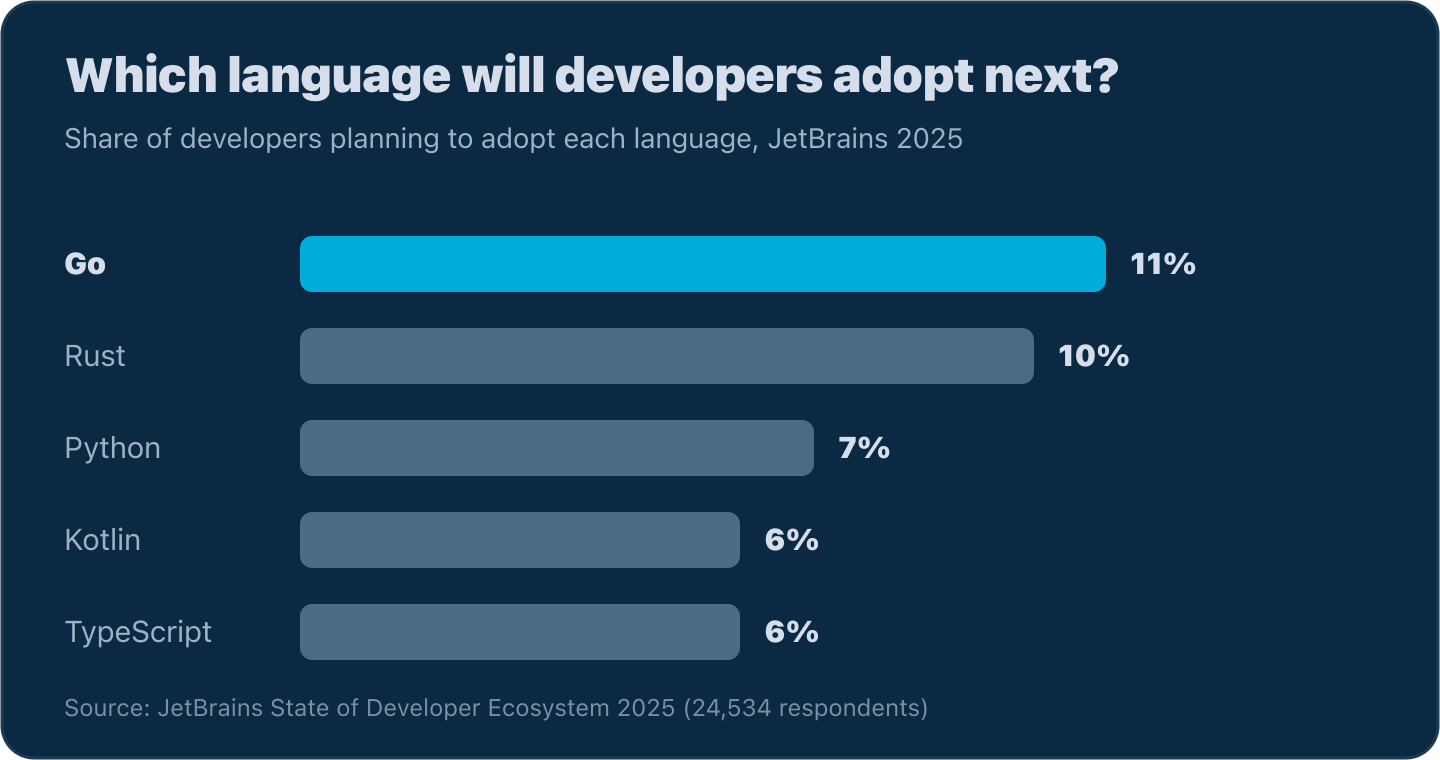
JetBrains' 2026 study of language migration found the same direction: of the languages it predicted would grow, "only Go showed actual growth" (JetBrains, 2026).
When is another language the right call?
Pick another language when your problem sits outside typical backend work or you already have a large team and codebase in another stack. These are the three cases where we would not start with Go:
- ML and data science. Python's libraries have no equivalent. A common pattern is to train models in Python and serve them behind a Go API.
- A large existing JVM or .NET system. Rewriting working software costs more than it saves. Build new services in Go where it makes sense, and keep the core where it is.
- No garbage collector allowed. Proxies, databases and services with hard latency limits are Rust territory.
flowchart TD
    Start(["New backend service"]) --> ML{"Is the core job ML or data science?"}
    ML -->|Yes| Py(["Python"])
    ML -->|No| Estate{"Joining a large JVM or .NET codebase?"}
    Estate -->|Yes| Stay(["Java or C#"])
    Estate -->|No| GC{"Are GC pauses unacceptable?"}
    GC -->|Yes| Rust(["Rust"])
    GC -->|No| Go(["Go"])

    classDef start fill:#0b2942,color:#d6deeb,stroke:#1d3b53,stroke-width:1px
    classDef question fill:#0b2942,color:#d6deeb,stroke:#1d3b53,stroke-width:2px
    classDef goPick fill:#00ADD8,color:#011627,stroke:#5DC9E2,stroke-width:3px
    classDef other fill:#0b2942,color:#d6deeb,stroke:#7a8fa3,stroke-width:2px

    class Start start
    class ML,Estate,GC question
    class Go goPick
    class Py,Stay,Rust other
Everything that doesn't fall into one of those three cases goes to Go. That includes most APIs, microservices, workers and internal platforms.
How do you start learning Go for backend development?
Start with the language basics, then build a real service. Go's small feature set means most developers who already know another language can write useful Go within a couple of weeks.
- Learn the fundamentals. Types, slices, maps, structs, interfaces, errors and goroutines. The free Go Fundamentals course covers them with an editor next to every lesson, and you only move on once your code passes the tests.
- Build projects. An API with a database, a background job queue, a cache. The Real-World Projects track has you build these from an empty repository.
- Follow a path. The LevelUpGo roadmap lays out the full order, from first program to concurrency, testing and production services.
If you're still weighing whether Go is worth your time at all, Is Go Worth Learning in 2026? looks at jobs, salaries and where the language is heading.
FAQ
Is Go better than Java for backend development?
For new services, usually yes. Go uses less memory, starts faster, deploys as a single binary and has far less framework to learn. Java is the better choice when you're extending a large Spring codebase or depend on JVM-only libraries. Java 21's virtual threads have narrowed the concurrency gap, but Go's model is simpler and has been the default since Go 1.0.
Is Python fast enough for backend development?
For many I/O-bound web apps, yes, because most of the time goes to waiting on the database. Python struggles with CPU-heavy work and high concurrency because of the interpreter and the GIL. The free-threaded build that removes the GIL is officially supported in Python 3.14 but still optional. Teams with heavy traffic often move hot services to Go.
Is Rust better than Go for backend development?
Rust is faster and has no garbage collector, but it takes much longer to learn and to write. For most APIs and microservices, Go gives you close enough performance with much faster development. Rust is the better pick for proxies, databases and systems where GC pauses are unacceptable.
What do big companies use for backend development?
Most large companies use several languages. Older enterprise systems tend to run on Java or C#, ML work runs on Python, and cloud infrastructure and many newer microservices run on Go. PayPal, Uber, Cloudflare, Twitch, Monzo and American Express all run Go in production, and Kubernetes, Docker and Terraform are written in it.
Is Go good for microservices?
Yes, it's one of the best choices. Small static binaries make container images tiny, services start in milliseconds, goroutines handle concurrent requests without extra frameworks, and gRPC and Protocol Buffers have first-class Go support. Most Cloud Native Computing Foundation projects are written in Go.
Is Go still growing in 2026?
It depends on the measure. The TIOBE index, which is based on search engine results, placed Go 12th in September 2026, down from 8th a year earlier. Surveys of developers show the opposite: JetBrains found Go was the language most developers planned to adopt, and its 2026 migration study found Go was the only language predicted to grow that actually did.
Which backend language should a beginner learn first?
Go is a strong first backend language. It has 25 keywords, one formatting style and a compiler that catches mistakes early, and its standard library teaches how HTTP, JSON and databases work without a framework hiding them. We cover this question in more depth in Should Go Be Your First Programming Language?.
Sources
- Stack Overflow Developer Survey 2025, Technology: https://survey.stackoverflow.co/2025/technology
- JetBrains, State of Developer Ecosystem 2025: https://blog.jetbrains.com/research/2025/10/state-of-developer-ecosystem-2025/
- JetBrains, The Go Ecosystem in 2025: https://blog.jetbrains.com/go/2025/11/10/go-language-trends-ecosystem-2025/
- JetBrains, Programming language migration (2026): https://blog.jetbrains.com/research/2026/08/programming-language-migration/
- Go Developer Survey 2025 results: https://go.dev/blog/survey2025
- Go 1.26 release notes (Green Tea GC): https://go.dev/doc/go1.26
- Go 1 and the future of Go programs: https://go.dev/doc/go1compat
- The Go Programming Language Specification: https://go.dev/ref/spec
- go.dev, Go for Cloud & Network Services: https://go.dev/solutions/cloud
- go.dev, PayPal case study: https://go.dev/solutions/paypal
- go.dev, case studies: https://go.dev/solutions/case-studies
- CNCF Annual Cloud Native Survey 2025 announcement: https://www.cncf.io/announcements/2026/01/20/kubernetes-established-as-the-de-facto-operating-system-for-ai-as-production-use-hits-82-in-2025-cncf-annual-cloud-native-survey/
- GitHub language breakdowns: https://github.com/kubernetes/kubernetes, https://github.com/hashicorp/terraform, https://github.com/moby/moby, https://github.com/prometheus/prometheus
- TIOBE Index, September 2026: https://www.tiobe.com/tiobe-index/
- OpenJDK, JEP 444: Virtual Threads: https://openjdk.org/jeps/444
- Microsoft Learn, Native AOT deployment: https://learn.microsoft.com/en-us/dotnet/core/deploying/native-aot/
- PEP 779, free-threaded Python phase II: https://peps.python.org/pep-0779/
- Node.js, The event loop: https://nodejs.org/en/learn/asynchronous-work/event-loop-timers-and-nexttick
- Node.js, worker_threads: https://nodejs.org/api/worker_threads.html
- PHP 8.0 release announcement: https://www.php.net/releases/8.0/en.php
- FrankenPHP: https://frankenphp.dev/